

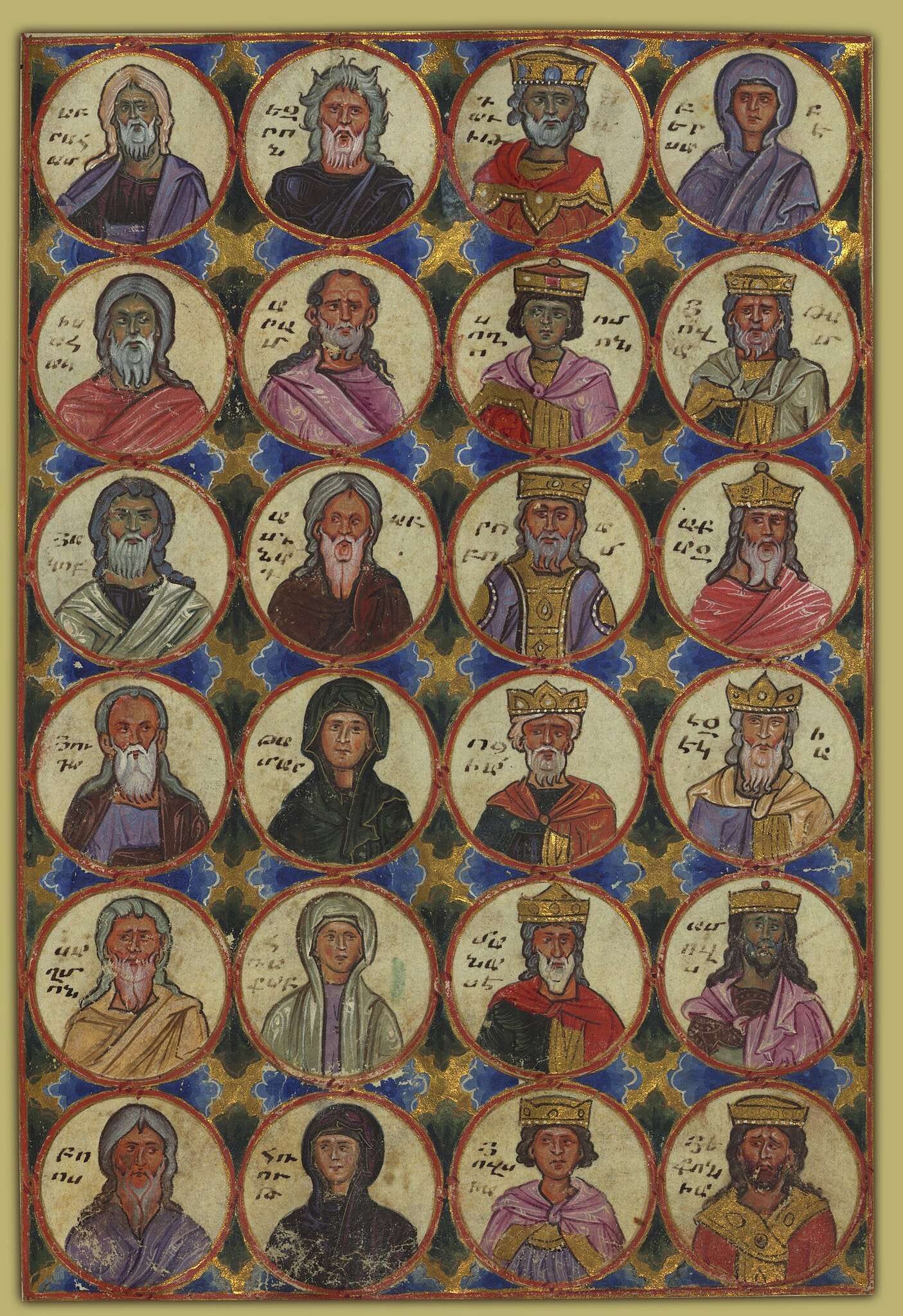
Ancestors of Christ,
Illumination by Toros Roslin (1210–1270),
Executed in 1262,
Ink, paint and gold on parchment
© Walters Art Museum, Baltimore, Maryland
In v1-17 Matthew begins with a genealogy (‘genesis’) of Jesus. His lineage from David and Abraham is highlighted. Abraham is the one through whose seed all nations would be blessed, and David’s son would be the ruler of God’s people forever. These are the big promises that Israel’s Christ was going to fulfil.
The genealogy follows Israel’s main turning points in history and includes some intentional ripples along the way. From Abraham to David the trajectory is upward to Israel’s first Kingdom. The ripples are the four Gentile women. They hint Jesus’ coming Kingdom will include all people, as he has already shown himself to be a son of Abraham including Gentiles in his line. And although in one sense at least three of them on the surface may seem morally dubious, in their role in the biblical narratives they all end up being commended for their righteousness (note: Bathsheba is not named but is called the wife of Uriah. Uriah having acted impeccably righteously in comparison to David), so it hints that the Lord will contribute to his work through Gentiles as well. The unusual births stories through which these women continue the messianic line also pave the way for the most unusual birth story ever to have occurred with Mary.
The genealogy from David to Babylon tracks Israel decent into the death of exile. The ripples here include four slight intentional variances or omissions. Asa is changed to Asaph, the psalmist and prophet who is cited in 13:35. Matthew’s referencing of him matches the theme of Israel going down into death but still clinging to hope of God’s mercy. Amon is also changed to Amos, the prophet who chastises Israel for their corruption and predicts their doom. The other ripples involve missing out a total of four generations, this makes this section 14 generations to fit the numerical point, Jesus comes at the beginning of the 7th week, as the one bringing the fulfilment of Sabbath rest, but the skipped generations also likely have their individual reasons for omission.
Lastly from Babylon to Jesus builds up to the time of promised Kingdom hope. Here priestly names appear to be highlighted, infusing Jesus’ lineage with the expectation he will be a priest-king. The climax shows God has indeed faithfully kept his promises to Israel, the Christ has been born with his credentials perfectly curated through the course of history, and the history shapes the course that Jesus’ ministry takes in the rest of the gospel.
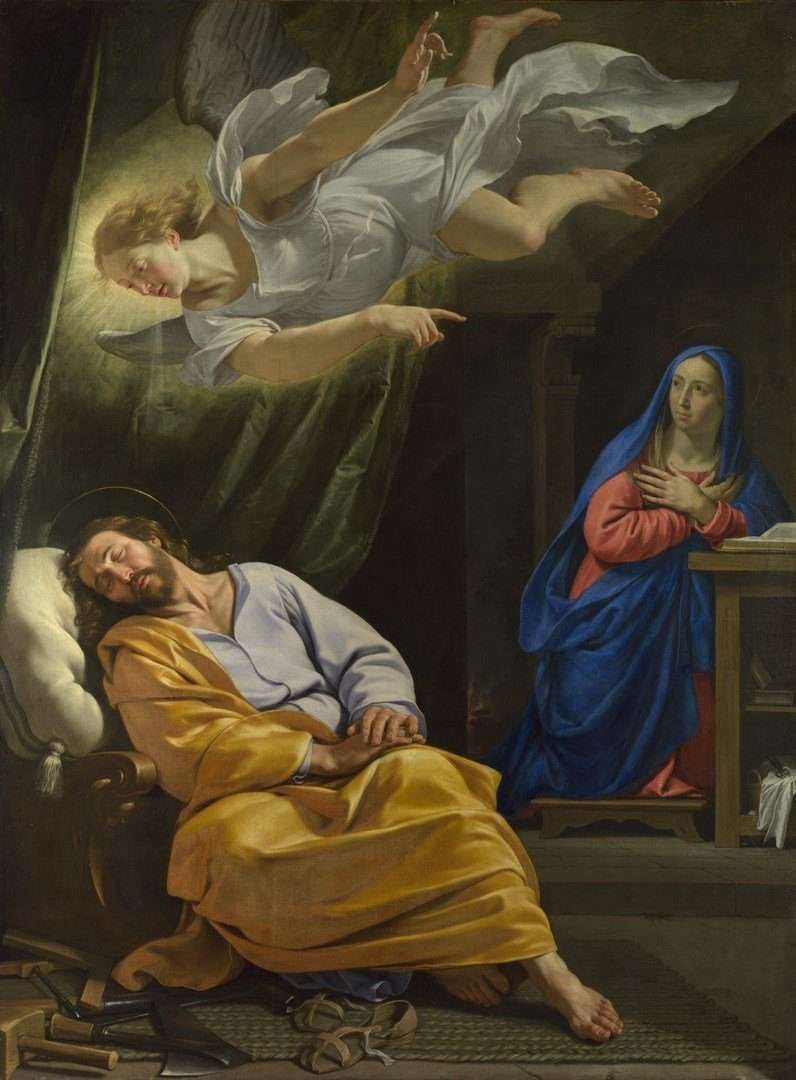
The Dream of Saint Joseph,
Painted by Philippe de Champaigne (1602-1674),
Painted in 1642,
Oil on canvas
© Getty Museum, Los Angeles
V18-25 contain another ‘genesis’ of Jesus, this time in narrative form. Miraculous births in the Bible symbolise new initiatives from God in the world. They all build up the THE new initiative in the birth of Jesus Christ. And like in the first creation, the Holy Spirit brings about a new creation, apart from the works of humanity.
Two names for Jesus are announced and explained or given context. He shall be called Jesus, for he shall save his people from their sins. The word for people here appears to be used in Matthew’s gospel to signify the Israelites, and here primarily he is seen as corporately saving them from their sins. That is, releasing them from the bondage that they placed upon themselves as a people because of their sin, and he is liberating them to be restored to their divine purpose. The name Jesus is the Greek form of Joshua, and the greater Joshua is saving his people and leading them into a greater promised land of the whole world. The restoration of Israel is essential to Matthew as it is through Israel that God’s universal and eternal King will rule salvifically for his glory. The forgiveness of individuals then, fits them into Jesus’ larger salvation story.
Then we see Jesus being the fulfilment of and the greater Immanuel – ‘God with us’. In the Isaiah passage Matthew showshows us what Jesus is fulfilling by being called ‘God with us’. It is not simply a static identity, but God being with them is how they will be delivered. So more fully the name could be glossed ‘God is with us to deliver us’. And that exactly what Jesus will do. Yet there is danger present as well, the initial deliverance in Isaiah, brought forthwas followed by a later judgement for those in Israel who were unfaithful, something Jesus will also predict for the coming generation in Israel.
Joseph is shown as the model disciple here. He is righteous, gracious and obedient to the word of God. He proves himself ready for the arrival of Jesus Immanuel, to take part in the promised restoration.
The genealogical determinism of the first genesis is added to by the nominative determinism of the second. Jesus has the credentials and the new creation power to be the son of Abraham, the son of David, the Son of God who has come to restore Israel, to save and rule the world.
Matthew 2 preparation questions:
Three ‘kings’ (Jesus, Herod and the Magi) are introduced in v1. What do we learn from their different exercises of kingship and how they react with one another throughout the chapter?
How would you evaluate Jerusalem’s response in v3-8 to the news in v1-2? And how should they have responded?
(If you are familiar with the Exodus story) How could the events of the chapter be described as a replay but also a reversal of the first exodus? (Hint: who reminds you of Pharaoh and Egypt?)
In the second half of the chapter there are three times Matthew says this happened to fulfil a prophetic expectation. (Two direct quotations from a prophet, one expectation from an amalgamation of ‘prophets’). Look up the wider context of the first two. What is the cumulative impact of these being fulfilled in quick succession?
How would you summarise what Matthew is teaching us in this chapter?
Write down any remaining questions you have.
Art selection comes from the website christian.art