

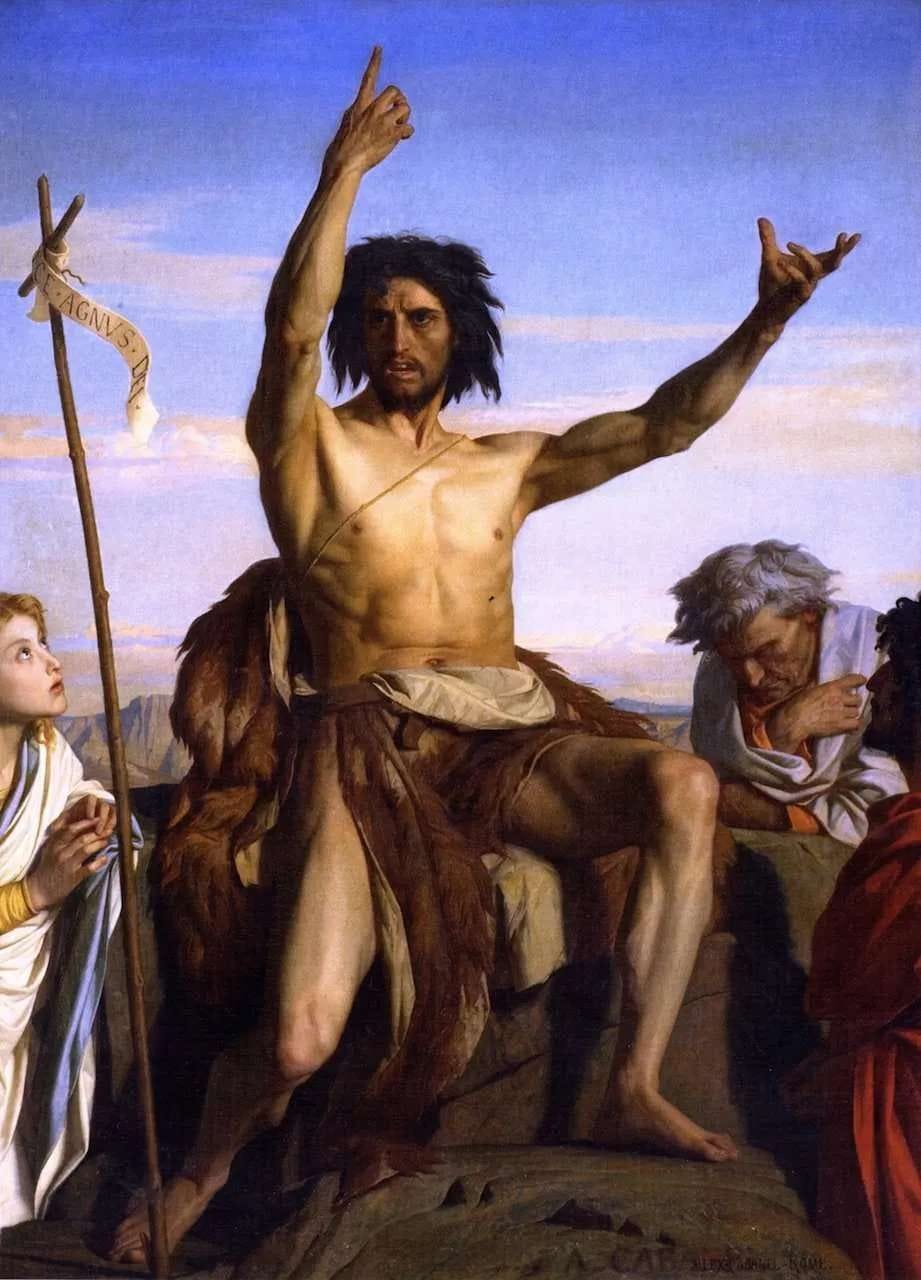
John the Baptist, Painted by Alexandre Cabanel (1823-1889), Painted in 1849, Oil on canvas, © Musée Fabre, Montpellier, France
‘In those days’ does not link temporally with the preceding chapter, given the around 30-year time gap, but eschatologically. The King has been reared and recognised, and has retreated to Galilee where he will continue to grow as the branch until the time of his public appearing. But there are two ‘appearings’ in this chapter: one prepares the way for the other and both together change the course of history forever.
Having seen the birth of the King from heaven, now John announces the time of his Kingdom is near. And John’s is an urgent message of repentance for Israel to be ready, and to be able to participate in it. He is in the wilderness, the place of new beginnings, where Israel once prepared to enter the promised land, and the path by which the Lord once returned them. But John is the final fulfilment of the herald of Isaiah who prepares the way for the Lord to conclusively return to his soil, city and sanctuary.
John comes dressed in the costume of Elijah. He appears in the reign of an Ahab, an evil king of Israel, this time one of the Herods. And like Elijah before him, he both warns of the unavoidable judgement of covenant curses to come and also gathers and prepares a new people to survive through that judgement. Because although the judgement is unavoidable, it is not inevitable that all Israel fall with it – there is a way through and a greater future beyond it.
Not all hope is lost for the people of Jerusalem either. Though they, and perhaps particularly their leaders, ignored the signs of Christ’s coming, being shown up by the Magi, they come out in force from there and all the heartlands of Judah to hear John. And he baptises them, as a sign of cleansing, a ceremonial washing, and a new birth out of the waters for a spiritually fledgling people. He did it in the Jordan, the place from which Israel crossed to conquer the land. Now they are consecrating themselves and preparing to follow their King as he comes to reconquer it, this time not from other abominable nations but from an abominable Israel. But to have any part in this renewed Israel, like Daniel did on the cusp of their previous return, the old Israel that comes to John needs to confess their corporate sins, to collectively beg the pardon of their coming King. It highlights for us the importance of verbal, accurate and corporate confession of sin, as we are part of the social body of the Kingdom.
Yet John has incredibly strong words for the Pharisees and the Sadducees as he sees them coming towards him across the horizon. Representing the lay and clergy leadership of the day, John says these groups have shown themselves to be seeds of the serpent rather than to be true seeds of Abraham. They hadn’t listened to the hope of a King from Bethlehem in Micah, so why have they come for baptism to take the warning of Malachi seriously? If they dare claim safety because of their pedigree and not from genuine repentance, if they think the Lord owes them something or needs them, they can easily be replaced.
The axe of the dominant empire, once Assyria and now Rome, is laid at the root of the trees ready to be picked up and swung by the Lord. Here the corporate wood is broken down into its constituent trees and individuals are warned about the need for good fruit. John says that he is nothing and his baptism is merely preparatory compared to the real baptiser and his coming baptism of fire, which will be terrifying for those who do not heed the warning, but transforming by the Spirit for those who do. As Malachi foretold, the Lord will indeed return to his Temple built on the threshing floor and will thresh and test what he finds.
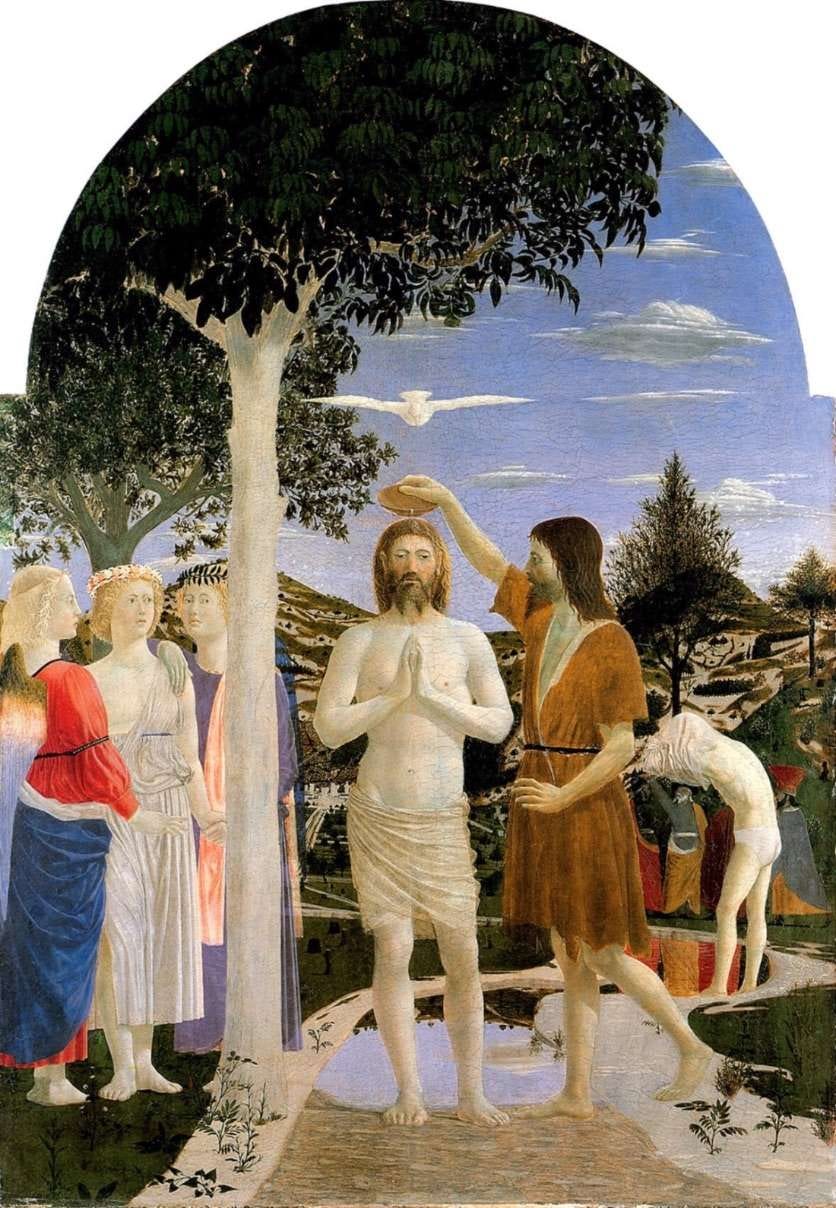
The Baptism of Christ, Painted by Piero della Francesca (-died 1492), tempera on panel, Painted in the mid 1450’s, © National Gallery, London
And here he comes now, as he appears on the scene from backstage in Galilee. The Jordan is highlighted again, bringing out its other point of fame as a place of transition. As Moses handed on the baton to Joshua, and Elijah handed on to the greater work of the Spirit in Elisha, so John, the last and greatest ‘Old Testament’ prophet, is about to transition to the new. It boggles John’s mind that Jesus would be baptised by him, surely, given everything he has just said, it should be the other way round. But it is a mark of the Lord Jesus that his first act of public ministry is to identify with sinners and commit himself to obediently following the plan of his Heavenly Father.
In Jesus’ baptism he opens up a doorway between heaven and earth. And like in the first creation we see the communion of the triune God, with the Spirit of God hovering over the waters. The likeness of a dove reminds us of the newly cleansed earth of Noah’s day, encapsulating what Jesus was here to bring about, salvation through judgement. And the voice of the Father identifies how he will do that. He is the Sovereign Son, David’s descendant and the Psalmist’s prophecy, Israel’s King who will rule the whole world. He is the beloved Son of Abraham’s sacrifice who will be the substitute for the sins of the whole world. And he is the servant Son of Isaiah, bringing tenderness and justice by the Spirit to the whole world.
The days have arrived, Jesus has appeared, and he has been publicly anointed. Jesus emerges from the waters of baptism like Israel from the waters of the Red Sea, as a new creation ready to establish his Kingdom. The Kingdom coming means that justice and righteousness will be brought to bear on Israel and then the whole world. How many in Israel will make themselves ready for his coming? And what will be the path of this newly anointed King as he looks to ascend to his throne?
Preparation questions for Matthew 4:1-11
What are the different links to the previous passage in chapter 3? And how does chapter 4 follow on from where chapter 3 left off?
What do we learn about the devil in this passage?
How do the tests/temptations escalate?
What do Jesus’ responses to the temptations teach us?
This passage draws on Israel’s wilderness testing in Exodus 16-18 (and Moses’ fast Exodus 34:28), Adam’s testing in Genesis 3:1-7. What to the similarities and differences between these tests and Jesus’ testing teach us?
Why is this testing in the wilderness key to Jesus’ Sonship and his route to his throne?
Art selection from website christian.art